
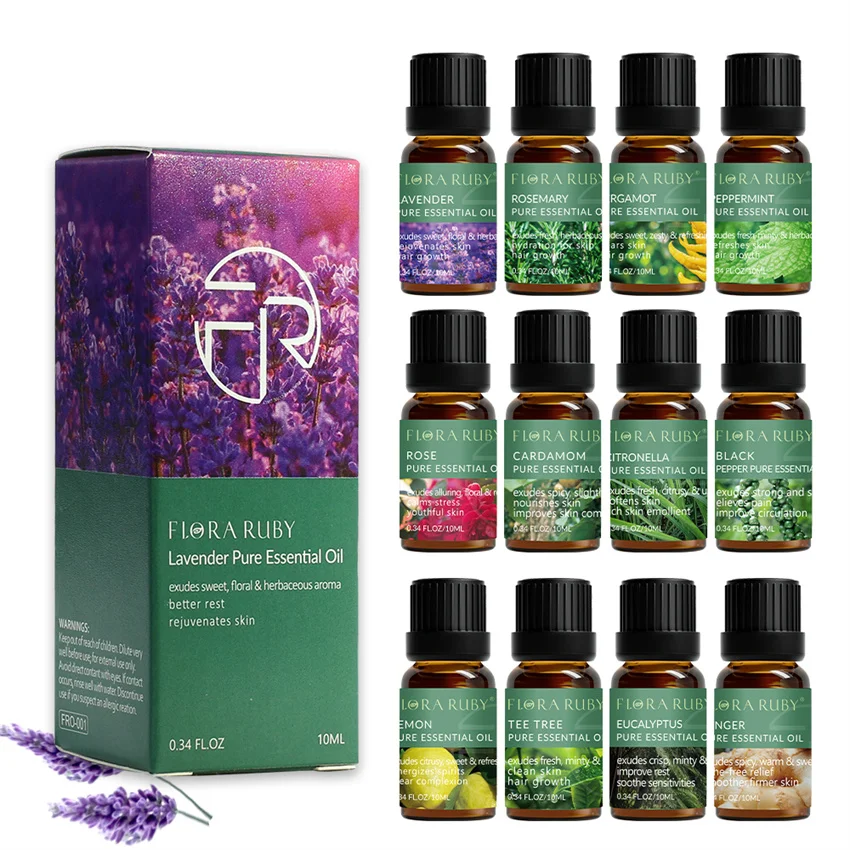
If you have just bought a diffuser and you are staring at a wall of little brown bottles, you only need five oils to cover almost everything you will actually use it for: eucalyptus, lavender, peppermint, lemon and tea tree. Everything else is refinement.
This guide covers which oils to buy first, how many drops to actually use, four blends worth making, whether a set beats buying singles, and which oils to leave alone if you have pets. Prices and options mentioned are ours, on the product pages linked throughout.
The five oils to buy first
Each of these does a job the others do not. Buy these before you buy anything exotic.
Eucalyptus
The one people buy a diffuser for in the first place. Sharp, clean and cooling, it is the scent most associated with steam rooms and spas. Useful in a bathroom, a home office or a bedroom during a cold. If you want the longer version of why it is worth diffusing, we have written that up separately in our guide to the benefits of eucalyptus oil in a diffuser.
Lavender
The evening oil. Soft, slightly sweet, and the one most people reach for an hour before bed. It also does the useful job of rounding off sharper oils, which is why it appears in half the blends further down.
Peppermint
Bright and cold. Good in a room you are working in, poor in a room you are trying to fall asleep in. A little goes a very long way, so use half what you think you need.
Lemon
The one that makes a room smell clean rather than scented. Works well in kitchens and hallways, and it lifts heavier oils that would otherwise sit flat.
Tea tree
Medicinal rather than pretty, and that is the point. Most people use it in a bathroom or a utility room where they want the air to feel fresh rather than perfumed. Read the pet section before you buy this one.
All five are available as individual 10ml single note oils, alongside another sixteen scents including rosemary, bergamot, frankincense, ylang ylang, grapefruit and pine needles.
How many drops you actually need
Most people use far too much oil, then wonder why the room smells overpowering and the bottle emptied in a fortnight. Drops scale with the water tank, not with how strong you want the scent.
- 100ml tank: 3 to 5 drops
- 200ml tank: 6 to 10 drops
- 300ml tank: 9 to 12 drops
- 500ml tank: 15 to 20 drops
Start at the bottom of the range. You can always add a drop, and your nose stops registering a scent after about twenty minutes anyway, which is why people keep topping up and end up with a room nobody else can sit in. Always follow the instructions that came with your diffuser, since tank sizes and output vary.
On running time, a 30 minutes on, 30 minutes off cycle gives a more noticeable scent than running it continuously, because your sense of smell resets in the gaps. Most diffusers have this built in as an intermittent mode.
Four blends worth making
Ratios below are for a 300ml tank. Scale up or down with the guide above.
Clear head: eucalyptus and peppermint
Six drops eucalyptus, three drops peppermint. The classic cold and blocked nose combination. Peppermint is the loud one, so keep it to a third or it takes over.
Wind down: eucalyptus and lavender
Four drops eucalyptus, six drops lavender. Softer than eucalyptus alone and more interesting than lavender alone. This is the one to run in the hour before bed.
Fresh kitchen: lemon and rosemary
Six drops lemon, four drops rosemary. Cuts through cooking smells without smelling like an air freshener. Rosemary is herbal rather than floral, which is what stops this being sickly.
Clean bathroom: tea tree and lemon
Five drops tea tree, five drops lemon. Tea tree on its own is quite austere. Lemon lifts it. If you like this pairing, the same two oils work well in homemade sprays, which we cover in our guide to using eucalyptus oil in natural cleaning products.
Singles or a set?
This depends on whether you already know what you like.
Buy singles if you know you want eucalyptus in the bathroom and lavender by the bed and have no interest in patchouli. A 10ml bottle costs roughly four to five pounds and, at five drops a session, gives you somewhere in the region of forty uses. That works out at around ten pence a session, and you are not paying for fifteen bottles you will never open.
Buy a set if you are new to this and do not yet know what you like, or if it is a gift. Sets come in 5ml bottles rather than 10ml, so you get less of each, but you get to find out whether you are a bergamot person before committing to a full bottle.
We stock three sets. The 15 piece eucalyptus and aromatherapy set is built around eucalyptus with lavender, mint, rose and tea tree alongside it, which covers the five jobs above in one box. The 15 x 5ml gift set is the one most people buy as a present. The MAYJAM 20 bottle set is the widest range, including sandalwood, jasmine and patchouli.
An honest word on the 20 bottle set: if you only ever run your diffuser in one room, you will use four of those twenty bottles and the rest will sit in a drawer. It is the right buy for someone who genuinely wants to experiment or who is diffusing in several rooms. It is the wrong buy if you just want your bathroom to smell like a spa, and in that case two 10ml singles will serve you better for less money.
The oils to skip if you have pets
This is the part most buying guides leave out, and it matters more than which scent you prefer.
Tea tree is the clearest problem. The ASPCA notes that in concentrated form it may cause issues for pets with only seven or eight drops, and lists unsteadiness, low body temperature, vomiting and diarrhoea as signs of exposure. If you have a cat or a dog with access to the room, this is the one oil on our list of five that is worth leaving out of your basket.
- Do not use a diffuser at all if you keep birds, whose respiratory systems are particularly vulnerable
- Do not use one if your cat or dog has any existing respiratory condition
- Keep the diffuser somewhere the animal cannot knock it over, and where it can leave the room if it wants to
- Run it in short bursts rather than all day
- Never apply any essential oil directly to an animal
Source: ASPCA, The Essentials of Essential Oils Around Pets. If you think your animal has been affected, ring your vet rather than waiting to see.
Keeping the diffuser working
Oils are slightly corrosive and they leave a film. Three habits stop the ultrasonic plate clogging, which is the usual reason a diffuser stops misting properly after a few months.
- Empty the tank after each session rather than leaving water standing in it
- Wipe the plate with a damp cloth weekly, and use a cotton bud on the disc itself
- Every few weeks, run it for five minutes with water and a small amount of white vinegar, then rinse
If you are in a hard water area, which covers most of the south and east of England, use filtered or previously boiled water. Limescale builds on the plate far faster than oil residue does.
What diffusing will and will not do
Worth being straight about this. Diffused oils make a room smell good and most people find certain scents calming or refreshing, which is a real effect and a good enough reason on its own. The evidence for anything beyond that is thin. Cancer Research UK, reviewing aromatherapy, puts it as there being some evidence that it might help with general wellbeing and anxiety, while noting more research is needed.
So buy oils because you like how your home smells and because a bathroom that smells of eucalyptus is a nicer place to start the day. Do not buy them expecting them to treat anything. If you have a persistent cough, a skin problem or anything else that is not going away, see a pharmacist or a GP.
If it is specifically the steam room effect you are after, a diffuser is not the only way to get it. Hanging fresh stems is the more traditional approach, and we have a step by step guide to hanging eucalyptus in the shower.
Frequently asked questions
Can I put eucalyptus oil in a humidifier?
Only if the manufacturer says so. Most humidifiers are not built for oils and the oil will degrade the plastic tank and void the warranty. Diffusers are designed for it, humidifiers usually are not.
How long does a 10ml bottle last?
At five drops per session, roughly forty sessions. Daily use puts that at about six weeks. Using it two or three times a week makes it last three to four months.
Do essential oils go off?
Yes, slowly. Citrus oils such as lemon and grapefruit are the first to turn, usually within a year or so of opening. Keep bottles closed, upright and out of direct sunlight, and they will last considerably longer.
Can I mix more than two oils?
You can, but three is a sensible ceiling for most people. Past that the individual scents stop being distinguishable and you end up with something generically perfumed.
Is tea tree oil safe to diffuse around children?
Diffuse in a well ventilated room, keep sessions short, and keep the bottle itself well out of reach, as swallowing concentrated oil is the serious risk. If a child has asthma or any respiratory condition, check with your GP or pharmacist first.
Where to start
If you want one bottle, make it eucalyptus. If you want a starter kit that covers most situations, buy eucalyptus, lavender and lemon as 10ml singles and add peppermint later. If you are buying for someone else, a 15 piece set gives them room to find their own preferences.
You can see everything together in our eucalyptus wellness range.